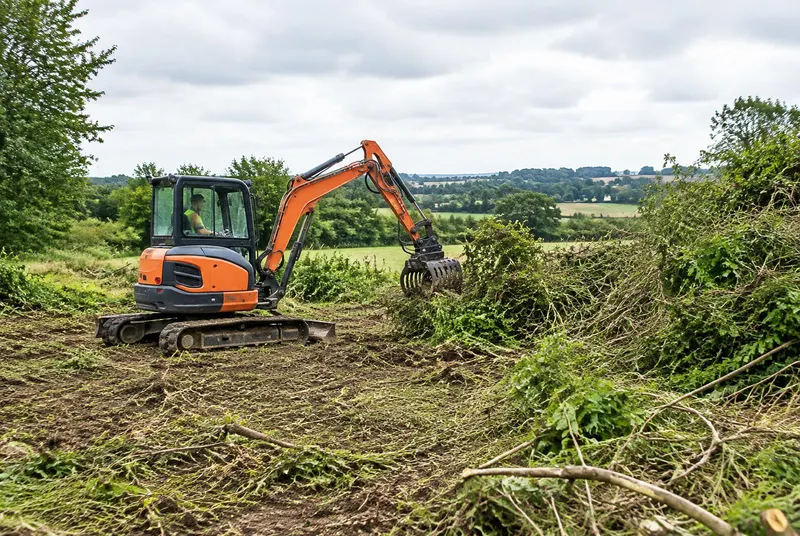
Bramble clearance that lasts
Cutting brambles at ground level is the easy part, and on its own it buys you one season. The roots stay alive and send up fresh canes, and any cane tip touching the soil has usually rooted as well. A proper clearance cuts the growth back, lifts or grubs out the root crowns and collects the rooted tips, which is the difference between clearing a patch and mowing it.
Where a bramble patch has been growing for years, there is often rubbish, old fencing or wire hidden inside it. That comes out too, and the ground is left clear enough to see what you actually have. If the plot turns out to need machine work, site clearances covers digger assisted clearance of larger areas.
Ivy removal from walls and fences
Ivy on a wall is not automatically a problem: on sound, well pointed brickwork it often does no harm and shelters wildlife. The trouble starts when it gets into loose mortar, under roof tiles, behind guttering or through a fence panel, where its stems thicken and lever things apart.
Removing ivy from a wall is done in stages. The main stems are cut at the base and the top growth is left to die back rather than ripped straight off, because pulling live ivy away takes mortar, render and paint with it. Once the growth has died and loosened, it comes away with far less damage. What is left at the base is dug or treated so it does not simply regrow.
Ivy in trees and hedges
Ivy growing up a tree trunk is common and is not by itself a reason to remove the tree. It becomes a concern when the ivy is so dense it hides the condition of the trunk and major limbs, or adds so much weight and wind resistance to the crown that a weak tree is more likely to fail. Where there is any doubt, severing the ivy at the base lets it die back so the tree can be inspected properly.
In hedges, ivy gradually outcompetes the hedge plants and leaves gaps when it collapses. Clearing it out of a hedge is fiddly hand work, but it gives the hedge its chance to thicken again. Ongoing garden maintenance can then keep regrowth under control as part of regular visits.
Keeping regrowth under control
Both plants are persistent. Bramble seedlings arrive in bird droppings, and ivy regrows from any root left behind. After a clearance, the options are regular cutting back through the growing season, or a maintenance visit that includes keeping cleared areas clear. Craig will tell you honestly what level of follow up your patch is likely to need.
All the cleared material is loaded and taken away. Brambles and ivy are bulky for their weight, so removal is a real part of the job rather than an afterthought.
Getting a price
Bramble and ivy work is quoted from the area covered, how established the growth is, whether roots need lifting, what the ivy is growing on and how the waste gets out to the vehicle. Photos showing the worst areas and the access route are enough for an initial view, or Craig can visit.
Send details through the quote form or call to talk it through. If the job is part of a bigger overgrown garden, it can be priced together with a full clearance.