Which fence is right for the garden?
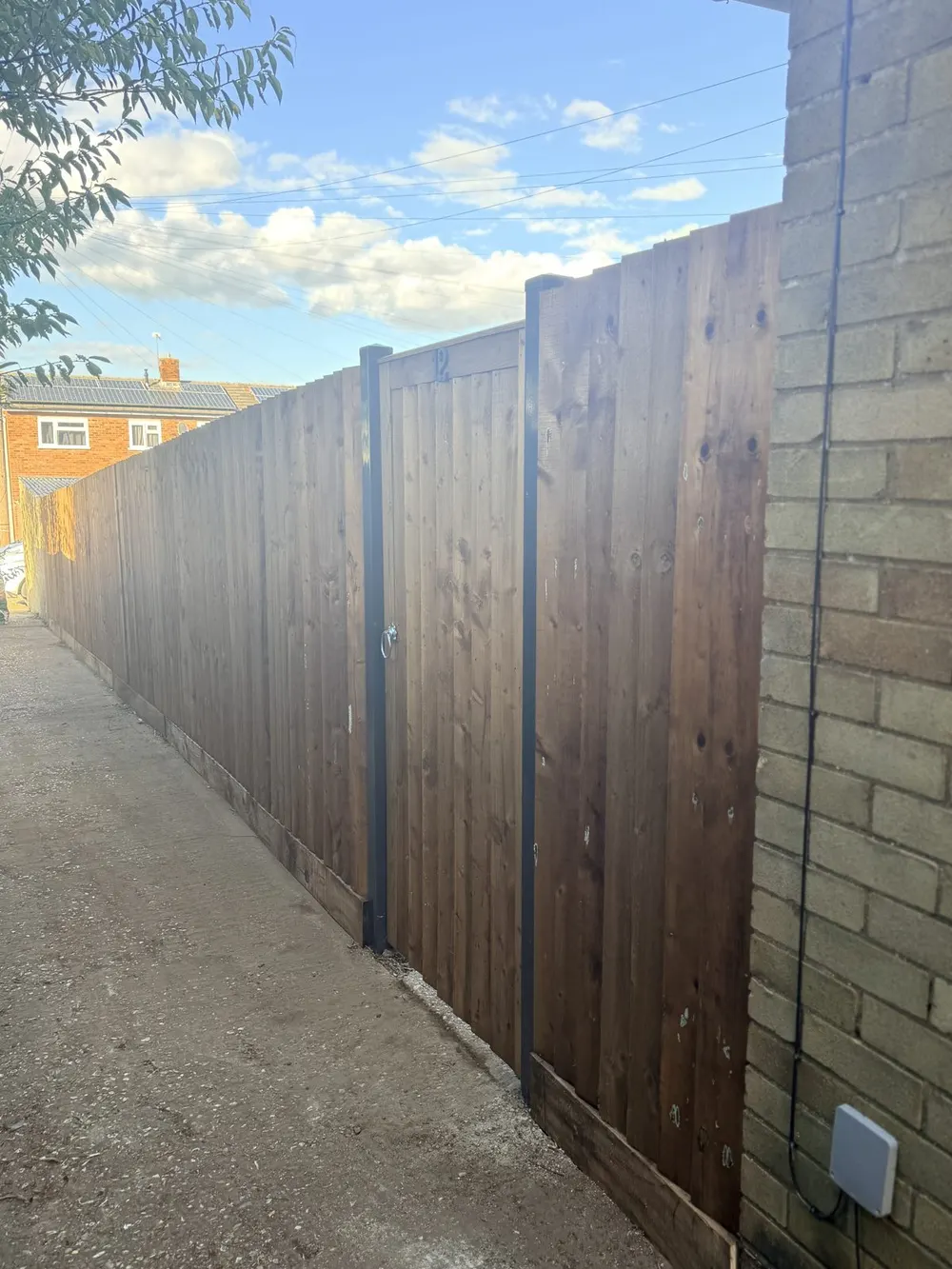
Fencing gives a garden a defined edge, privacy where you need it and a practical opening where people need to pass. Foundation installs and replaces fencing, including timber fence runs and garden gates. Craig's photograph shows one of his completed jobs: a feather-edge timber fence with concrete gravel boards and a matching gate with a ring latch. It shows a real example of the finish, but your own boundary may call for a different style or post arrangement.
The first decision is what the fence needs to do. A solid screen can make a seating area more private. An open boundary may be enough to define the edge of a larger plot without blocking the view. If the ground falls away, there is an existing wall, or a side access needs a gate, those details shape the design. Craig can look at the line and discuss the options before quoting the agreed work. Foundation works across its stated Suffolk and Norfolk area.
Common fence types
Feather-edge, also called closeboard-style fencing, is made from overlapping upright timber boards on horizontal rails. The overlap gives a continuous-looking screen. It is a useful choice when privacy is important or the boundary does not fit neatly into standard panel widths. The rails and posts behind the boards are just as important as the visible face, so the specification should describe the whole construction, not only the board style.
Panel fencing uses pre-made sections fixed between posts. Different panel designs give different levels of screening. A simple solid panel and a decorative open-top panel do not do the same job, even though both are sold as panels. Think about the appearance from both sides and how the last section will fit if the run is not an exact multiple of panel widths.
Picket fencing uses spaced upright pales. It marks an edge without creating a solid visual barrier, and is often chosen where a lighter, more open look makes sense. Post-and-rail is more open still: horizontal rails run between upright posts to mark a larger boundary while keeping views through it. Neither picket nor post-and-rail should be described as a privacy screen. Choosing among these types starts with the purpose of the boundary, not a catalogue picture.
Posts, gravel boards and the ground beneath
A fence is only as sound as its support. Timber posts give an all-timber appearance. Concrete posts have a different look and are often combined with timber infill. Which suits a garden depends on the intended finish, access for materials and the condition of the ground. Concrete posts are heavier to handle; timber posts need careful thought where moisture can linger at ground level. A site inspection is better than declaring one material right for every boundary. Our guide to concrete or timber fence posts compares the two in more detail.
Gravel boards run beneath the main boards or panels. They separate the main fence from soil splash and direct contact with the ground, and help finish the lower edge. They can be timber or concrete. In Craig's photograph the concrete gravel boards can be seen beneath the timber. If a flower bed, gravel area or new lawn is planned beside the fence, discuss its final level before setting the posts. Soil piled against timber can hold damp against it, even when there is a gravel board elsewhere on the run.
A boundary may have old post holes, rubble, roots or buried services. These affect where and how new posts can be set. Uneven ground also affects the line of the top and the size of gaps at the bottom. Craig will need to see those conditions to agree a sensible layout. A fence that looks straight in a photograph may require more careful setting out than a fence across level, open ground.
Garden gates that work with the fence
A gate should fit the opening and the way you use it. A narrow pedestrian gate and an opening for moving bins or garden equipment have different needs. Hinges, latch position, the direction of swing and clearance over sloping ground all matter. A gate that catches on a path or cannot open fully is frustrating however neatly the fence itself is built.
Matching timber facing can make a gate look like part of the fence rather than an afterthought. Craig's own job photograph shows a timber gate set into a feather-edge run, with a ring latch that is visible from the path. The gate has its own supporting posts and needs a practical gap to swing freely. When discussing a quote, say which side you need to enter from, whether the latch must be reachable from both sides and what has to pass through the opening. These small choices make a large difference to daily use.
Replacing rotten or storm-damaged fencing
A broken panel does not always mean the entire boundary needs replacing. If surrounding posts are sound, a local repair might be enough. Equally, fitting one new panel between posts that move in the wind will not solve a failing structure. Rot at the foot of timber posts, loose footings, split rails and multiple leaning bays are signs the support needs attention as well as the visible boards.
Storm damage can expose weak points already present in an older fence. Photograph the affected line and keep people clear of unstable sections, especially if boards or posts could fall into a path. Craig can assess what should be taken out and what can remain. If the old fence has collapsed across planting or a narrow access route, that changes how the old material can be removed safely.
Replacement also provides a chance to reconsider the line. Perhaps a gate never opened properly, the bottom boards were in contact with wet soil, or an overgrown hedge made maintenance impossible. These are useful details to mention before the new fence is specified. Do not assume that repeating the old layout is necessarily the best answer.
What happens on a fencing job
The work begins with a survey of the boundary. Craig discusses the purpose of the fence, measures the run, looks at access and ground conditions, checks what is already there and talks through the requested style. The quotation should make clear what will be installed and whether removal of the existing fence and waste is included. If the fence sits on a shared boundary, establish the correct line and speak to the neighbour before work starts rather than trying to settle ownership during installation.
Where replacement is agreed, the old fence comes down in a manageable sequence. Existing posts and footings may need lifting before a new line can be marked. This is when access for carrying timber and removing old materials matters most. Areas close to planting, paving or a building may require more careful hand work than an open run. Buried pipes or cables need to be considered before digging new holes.
Next the post positions are set out and the posts installed to suit the chosen construction. The installer then fits either the panels or the rails and individual boards, adds gravel boards where specified and hangs any gate with its hinges and latch. The line, gate movement and fixings should be checked before the job is handed over. The final stage is clearing the offcuts and agreed waste and leaving the working area tidy. If other landscaping is planned, doing the disruptive boundary work before laying new turf usually avoids unnecessary traffic over a fresh lawn.
Boundary height and permissions
In England, general permitted-development guidance commonly allows a fence up to 2 metres high without planning permission away from a highway. Next to a highway used by vehicles, the usual limit is lower, commonly 1 metre. These are general rules, not a substitute for checking your own property: listed buildings, local restrictions and the exact relationship to a road can change what is allowed. The height may also need to be measured from a particular ground level where land slopes.
Before changing a boundary, check the relevant planning guidance with your local council if the height or position is uncertain. A title plan can help identify a boundary, but it does not by itself settle every ownership dispute or show the exact legal line on the ground. Discuss shared fencing with neighbours early. A contractor can work to an agreed position, but should not be asked to adjudicate a disputed boundary.
Getting a useful fencing quote
Send a photograph of the whole run, plus close-ups of any broken posts, ground-level rot or gate opening. A rough length, the height you have in mind, the style you prefer and any access restrictions help Craig understand the job. Mention whether the old fence must be removed, whether plants need protecting and whether a new gate is part of the work. There is no honest single price without those details and a look at the site.
If you are deciding between a continuous feather-edge run and separate panels, read our comparison guide. If you need to understand why replacement quotations differ, the cost-factors guide explains what to check without inventing prices. When you are ready, call Craig or send your job details through the contact form.