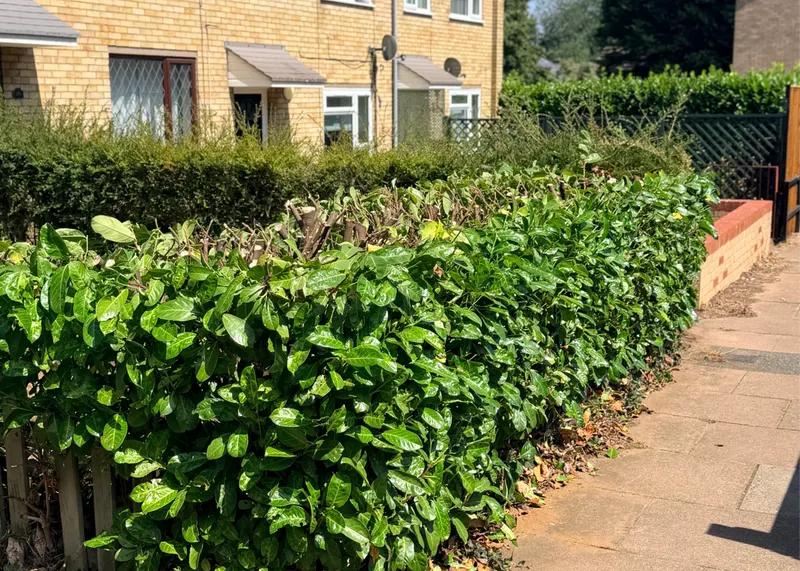
Conifer hedge removal and Leylandii reduction in Brandon
We remove conifer and Leylandii hedges completely, roots and all if needed, or reduce them where you want to keep some screening. Craig looks at the height, the boundary and what you want in its place, then quotes for the whole job including taking the waste away.
A tall conifer hedge produces far more material than most people expect, so the plan always covers how the waste leaves the site as well as how the hedge comes down.
One customer review on our home page reads: "Craig did a fantastic job clearing my large conifers. He was prompt, tidy, and removed all the debris."
Fully insuredProfessional work with responsible site care.
Local coverageAcross Suffolk and Norfolk.
Remove it or reduce it?
For a boundary containing other hedge types as well as conifers, see our hedge removal service.
The deciding fact with conifers is that most of them, Leylandii included, will not grow back from bare brown wood. If a hedge has to be cut back beyond its green growth to get it to a manageable height or width, the result can be a permanent brown face. That is often the point where removal becomes better value than repeated cutting. Our guide to hedge removal cost explains what shapes the price.
Where the hedge is still green close to the size you want, a reduction keeps the screening and buys years of easier trimming. Craig will tell you honestly which side of that line your hedge sits on.
Leylandii hedge removal step by step
Removal starts from the top and works down in manageable sections so nothing falls onto fences, sheds or a neighbour's garden. The branches are cut back to the trunks, the trunks are taken down low, and everything is gathered for loading.
Check for nesting birds before any cutting
Agree access and where material will be loaded
Cut the hedge down in sections from the top
Grind or dig out the stumps if the ground is needed
Rake the boundary clear and remove all waste
Leylandii reduction to a sensible height
Reducing a Leylandii hedge means taking the top down and trimming the sides back while staying in the green growth. Done at the right time and repeated regularly, it stops the hedge running away again. Our guide on how often to trim a hedge covers the timing for conifers in more detail.
What drives conifer hedge removal cost in the UK
We do not quote fixed figures online, because two hedges of the same length can be very different jobs. These are the main factors behind the price.
Height and depth of the hedge
Length of the run and number of trees
Access for equipment and loading
Whether stumps stay, are ground or are dug out
Volume of green waste to be taken away
Fences, buildings or neighbours close to the work
Rules worth knowing before you start
It is an offence to damage or destroy an active bird's nest, so a conifer hedge should be checked before work, especially through spring and summer. If the hedge sits in a conservation area or contains a protected tree, permission may be needed; our tree permission guide explains how to check.
If it is a neighbour's evergreen hedge causing the problem, councils can deal with high hedge complaints, but that process expects you to have tried to resolve it with the owner first.
After the hedge has gone
Removing a long conifer hedge often leaves a boundary that needs something new. Once the ground is clear, the same visit can be planned around fencing, turf or a new planting area, so the garden does not sit half finished.
Usually not from bare brown wood. Cutting back beyond the green growth tends to leave a permanent brown patch, which is why heavy reductions often become removals.
How much does conifer hedge removal cost?
It depends on height, length, access, stump work and the volume of waste. Send photos and the location for an initial estimate.
Do you take all the waste away?
Yes. We are registered waste carriers and remove the branches, trunks and clippings as part of the job.
Can you put up a fence once the hedge is gone?
Yes. Fencing is one of our services, so the new boundary can be planned at the same time as the removal.