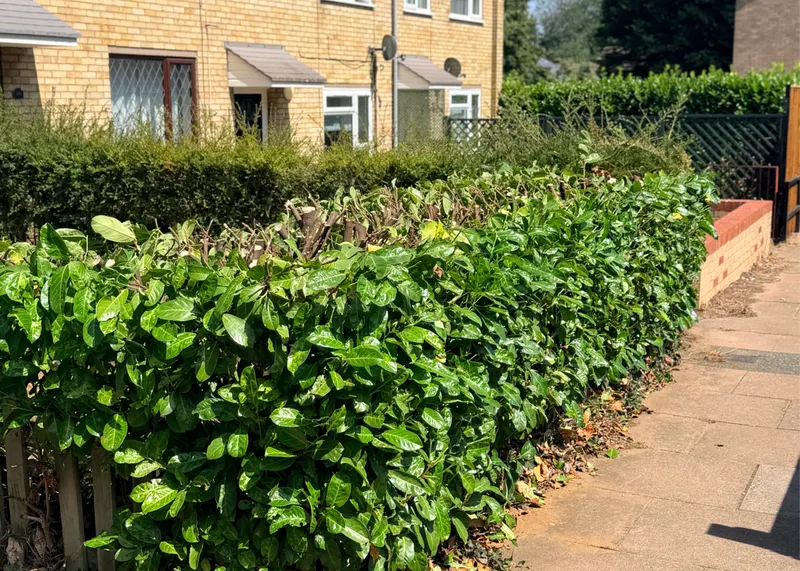
Identify the laurel and intended outline
Cherry laurel and Portuguese laurel differ in foliage and growth habit, while individual cultivars vary further. The common name alone is not enough to predict a sensible finished size. Look at the hedge's condition, available width and the screening you want to retain.
A slightly tapered outline, with the top narrower than the base, can help lower foliage receive light. Paths, windows and neighbouring boundaries may restrict the final shape. The hedge cutting hub explains how routine shaping differs from substantial changes to an established hedge.
Secateurs and visibly shredded leaves
Laurel's broad leaves make cutting marks conspicuous. A powered hedge trimmer can slice through leaf blades, leaving ragged edges that later turn brown. This does not necessarily mean the hedge is diseased, but it can affect the appearance, particularly on a prominent face.
Selective cutting with secateurs, shortening shoots to suitable points behind retained leaves, can produce a less visibly shredded finish. It takes a different approach from rapidly shearing a flat surface. The practical choice depends on hedge size, access and the finish being discussed, rather than a promise of unmarked foliage.
Routine trimming and suitable timing
A maintenance trim controls recent extension growth without substantially changing the woody framework. The interval depends on vigour, exposure and how formal the boundary needs to look. Repeated close clipping is not automatically the best response to every long shoot.
Weather, plant condition and active nests affect the appropriate date. Late spring or summer maintenance may suit healthy laurel, while major renovation is a separate operation to assess. Nests in use or being built remain protected whenever present. Do not assume a previously booked visit can proceed regardless of what is found.
Reducing an overgrown screen
Laurel can often produce shoots from older wood, unlike many conifer hedges. That makes substantial reduction possible in some circumstances, but recovery depends on plant health and conditions. A hard cut may expose bare stems and temporarily remove much of the privacy.
Staging work can sometimes retain more screening while the cut area responds. The appropriate sequence depends on the hedge, not a universal rule. Compare Leylandii hedge cutting if you are unsure which kind of evergreen boundary you have; its limits are not the same as laurel's.
Removal and the roots left underneath
First establish ownership, restrictions, access and the intended use of the cleared strip. Above-ground growth is taken down in controlled sections, with surrounding features considered. Stump and root treatment is a separate decision, not an automatic consequence of cutting stems.
Laurel may regrow from retained living stumps. Grinding or excavation needs discussing alongside buried services and nearby structures. The hedge removal page explains that broader scope. Laurel hedge removal cost depends on the size of the woody growth, root work, carrying route and disposal, not a plant-shopping price.
Cuttings, access and a useful quotation
Laurel foliage should be kept away from livestock and children. Avoid crushing or shredding it in enclosed spaces, and do not assume familiar garden leaves are harmless. Agree where material will be gathered and how it will leave rather than creating accessible heaps beside grazing animals.
The hedge cutting prices guide sets out quotation factors without guessing a figure for your hedge. Show its full length, height, base and access route, and explain whether screening must remain. These details distinguish a recurring laurel hedge trim from a major reduction or complete removal.