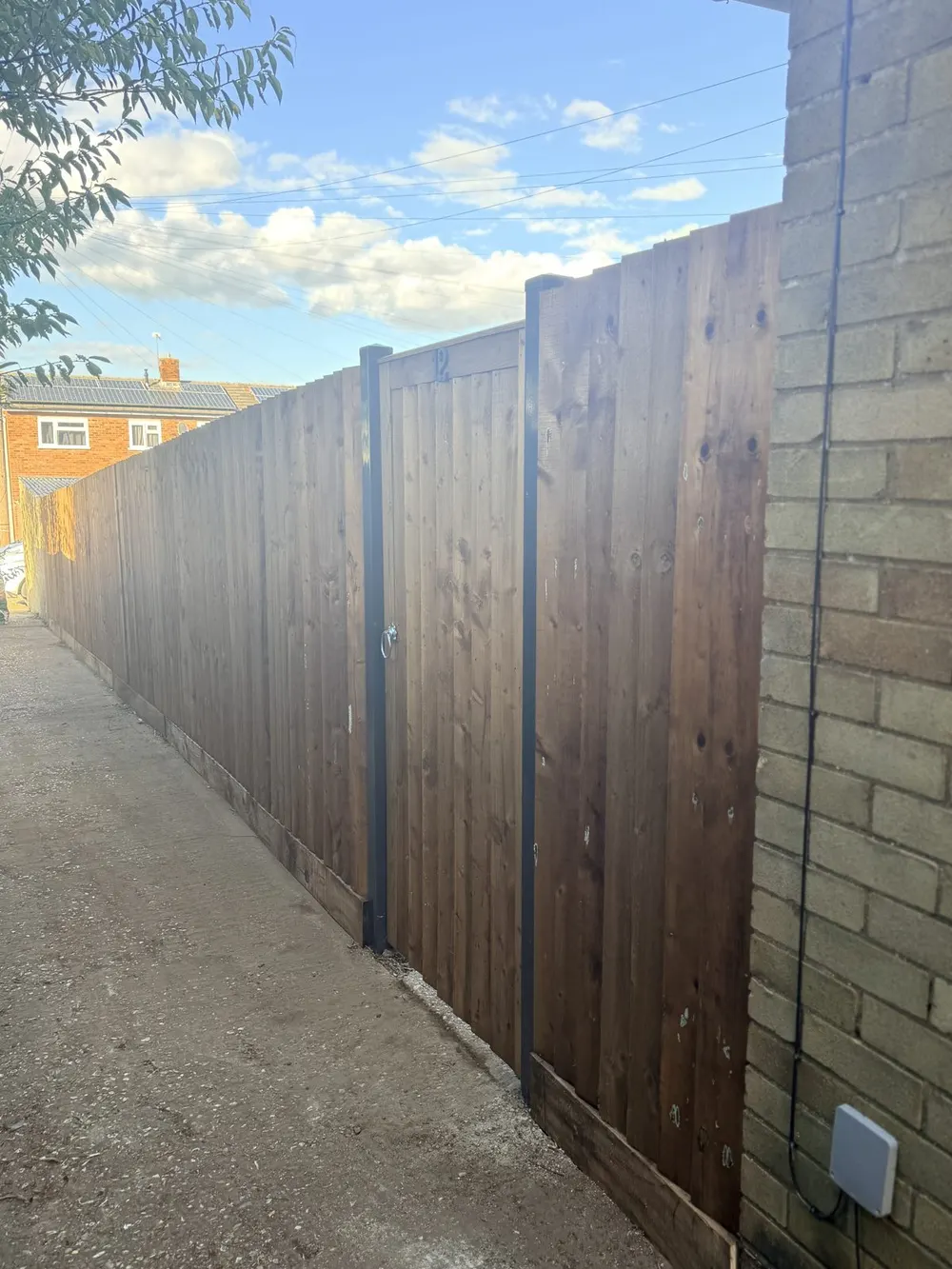
Where post and rail fits
This style suits open land where you want a boundary that is strong and visible without blocking the view: paddocks and grazing fields, driveways into rural properties, orchards and the boundaries of larger gardens. For gardens that need privacy rather than an open boundary, close board or panel fencing is the better choice, and the close board fencing page covers that.
Post and rail also works well alongside land management. A fenced paddock can be rested and rotated, and keeping the grass inside it under control is straightforward with paddock mowing.
Posts, rails and how many you need
A standard post and rail fence has two or three horizontal rails between upright posts. Two rails suits a decorative boundary or a field edge where nothing is pushing against it. Three rails is the usual answer for horses and ponies, because it closes the gaps a foal or a determined pony could get through and gives the fence more strength where animals lean or rub.
For sheep, goats or poultry, rails alone are not enough and stock netting or wire mesh is fixed to the rails to stop smaller animals slipping through. The spacing between posts, the depth they are set and the rail count are agreed on site around what you are keeping in, or out.
Setting out the fence line
The line of the fence is agreed first: along the true boundary, around the areas you want to graze, and with gates where you actually need to get a vehicle or wheelbarrow through. Corners and gate posts take the strain of the whole run, so they are set deeper and braced where the ground is soft.
Ground conditions matter as much as the timber. Sandy Breckland soil holds posts differently to heavy clay, and wet low ground needs posts set to a proper depth to stay upright through winter. Gates are hung to swing clear of the ground and fastened so they can be opened one handed from horseback.
Timber and looking after the fence
Posts and rails are pressure treated timber, chosen to cope with years in the ground and the weather. Rails are fixed so they shed water rather than hold it, and timber is checked for soundness before it goes in. Our guide to concrete versus timber fence posts explains the trade offs for garden fencing; for post and rail in paddocks, timber posts are the norm because they take the rails and netting naturally.
A post and rail fence is easy to live with: individual rails can be replaced when one breaks, and a walk along the line once or twice a year catches loose fixings and leaning posts before stock finds them.
What installation costs
Post and rail fencing is quoted per job rather than at a fixed metre rate. The price reflects the total length, the number of rails, the timber specification, the number of corners and gates, ground conditions and how far materials have to be moved from the vehicle to the fence line.
The clearest way to get a price is to send Craig the rough length, what the fence needs to hold and a few photos of the ground, or arrange a visit to walk the line together.