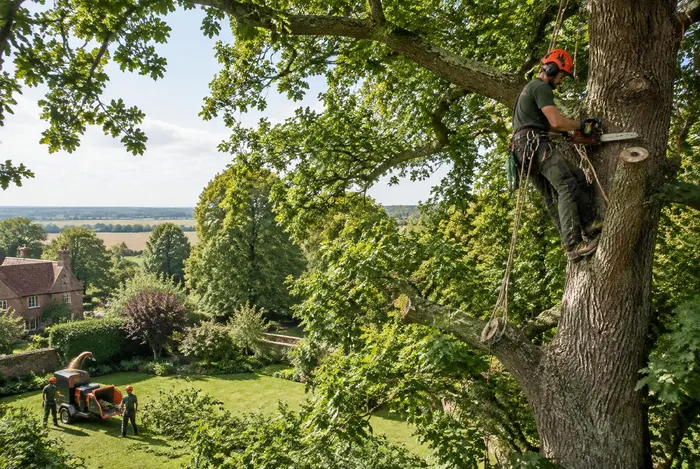
Which crown job does your tree need?
Start with the problem rather than the term. If a tree has simply grown too big for its spot, too tall over the house or too wide across the lawn, a crown reduction is usually the answer. Each main limb is shortened back to a suitable side branch, so the canopy shrinks evenly instead of ending up with flat, chopped ends.
If the size is acceptable but the garden underneath is dark, or the canopy looks dense and heavy, crown thinning removes a proportion of the smaller inner branches. The tree keeps its height and spread, yet light reaches the ground and the crown catches less wind.
If the trouble is low branches, crown lifting is the targeted fix. Limbs brushing a roof, blocking a drive, hanging over a footpath or shading a vegetable patch are taken off up to an agreed height. A sensible lift leaves plenty of canopy above, so the tree is not left top heavy.
Crown reduction pruning, done in proportion
A reduction is measured in metres taken off the outer edge, not as a percentage of the whole tree. A typical request is something like one or two metres off the spread, finished to a natural shape. Cuts are made back to growing points that can take over, which helps the tree seal the wounds and keeps regrowth tidy.
Not every tree suits heavy reduction. Old or weakened trees, and species that react poorly to large cuts, may be better with a lighter reduction repeated over time. That conversation happens on site before a price is given. Where a tree is too large, too close or in poor condition for pruning to solve the problem, our tree surgery service covers felling and larger work.
Crown lifting trees over drives, paths and lawns
Crown lifting is one of the simplest ways to make a garden easier to use. Removing a few low limbs can give a van room to reach the drive, let a mower pass under a tree, or open a view. It suits many broadleaves and some conifers, though on young trees it is usually done in stages so the trunk can thicken properly.
For lighter shaping, deadwood and general tidying across several trees, see our tree pruning service. For trees cut back to a framework on a repeating cycle, see pollarding, which is a different technique with its own timing.
Permission checks before any cut
Trees covered by a Tree Preservation Order need council consent for crown work, and trees in a conservation area normally need six weeks' notice to the council first. It is worth checking before booking. Our guide to tree preservation orders explains how to find out and what the council usually wants to see.
Nesting birds are also protected, so spring and summer work starts with a look through the canopy. Many owners prefer to plan crown work for late autumn or winter, when the leaves are off and the shape of the branches is clear.
What a quote is based on
There are no set prices on this site because crown work varies so much from tree to tree. A quote reflects the height and spread of the tree, how much is coming off, whether the work is done by climbing or from a platform, what lies underneath, how easy it is to get branches out to the road and whether the brash is chipped and taken away. Our tree pruning cost guide goes through those factors in more detail.
To get started, send Craig a photo of the whole tree, a note of what is bothering you and your rough location. You can call or use the quote form below.