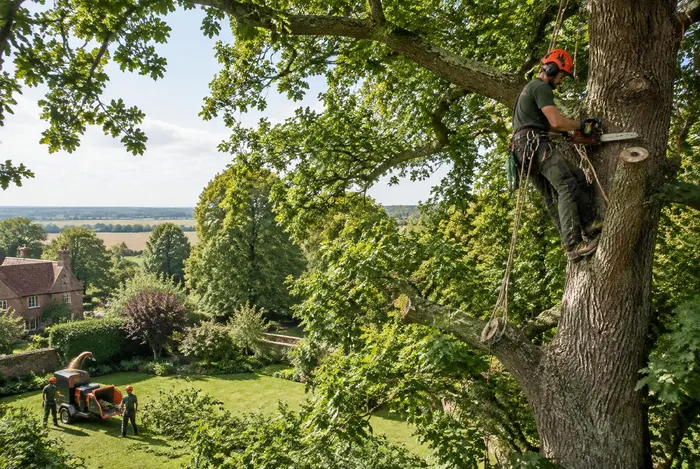
Choose the work around the problem
If branches are obstructing access or a crown has become difficult to accommodate, begin with tree surgery. The useful question is what needs to change: clearance above a route, the spread towards a building, or the condition of particular branches. Those concerns do not automatically call for the same operation, and removing a tree is not the only possible answer.
For boundaries that have grown too broad or tall, hedge cutting addresses a different kind of growth. Routine trimming and substantial reduction should not be treated as interchangeable. Species, existing bare wood and the amount of living growth left behind all affect what is sensible.
Old centre, established suburbs and newer estates
King's Lynn's old centre includes tightly arranged buildings and enclosed outside spaces, where getting material from the garden to the street can influence the whole job. A passage, shared entrance or restricted parking space needs to be discussed before work is specified. Photographs should show the route out as well as the tree itself.
Gaywood, South Wootton and North Wootton contain a mix of established gardens and more recent housing. Older plots may have mature trees close to extensions or boundaries, while estate gardens can offer less room for a spreading crown. These are starting points for inspection, not assumptions about every property. West Lynn, across the Great Ouse, also needs its own access and exposure assessment rather than being treated as an identical setting.
Plan changes in the right order
Where several parts of the garden need attention, decide what must remain before clearing anything. Retained trees, useful screening, paths and access for future maintenance all belong in the plan. Landscaping can then address how the space will work, rather than arranging new features around an unresolved tree or boundary problem.
A replacement fence may need to follow tree or hedge work so that posts and finished boards are not in the working area. The King's Lynn fencing page explores local boundary decisions, while the main fencing service explains the broader options. An attractive boundary still needs suitable support and a position agreed against the available ownership information.
Permissions, wildlife and the agreed scope
Before tree work is booked, check whether a Tree Preservation Order applies or whether the tree stands within a conservation area. Consent or notice may be required, depending on the circumstances. The local planning authority can confirm the relevant process. An apparently inconvenient tree is not automatically exempt, and a neighbour's agreement does not replace statutory permission.
Bird nests and potential bat features also affect planning. Discuss checks, timing and any need for specialist advice before cutting. The written scope should distinguish pruning from removal and say what happens to branches, timber and any stump. Avoid assuming that every element is included simply because the overall request is described as tree work.
Make the first enquiry useful
Send the location, several photographs and a short explanation of the problem. Include gates, steps, nearby structures and anything beneath the canopy that needs protecting. If vegetation prevents a clear view, garden clearance may form part of the discussion, but clearance should not become permission to remove everything.
For recurring upkeep rather than a single tree operation, see gardening in King's Lynn. Keeping routine care separate from specialist tree decisions makes it easier to describe the work accurately.