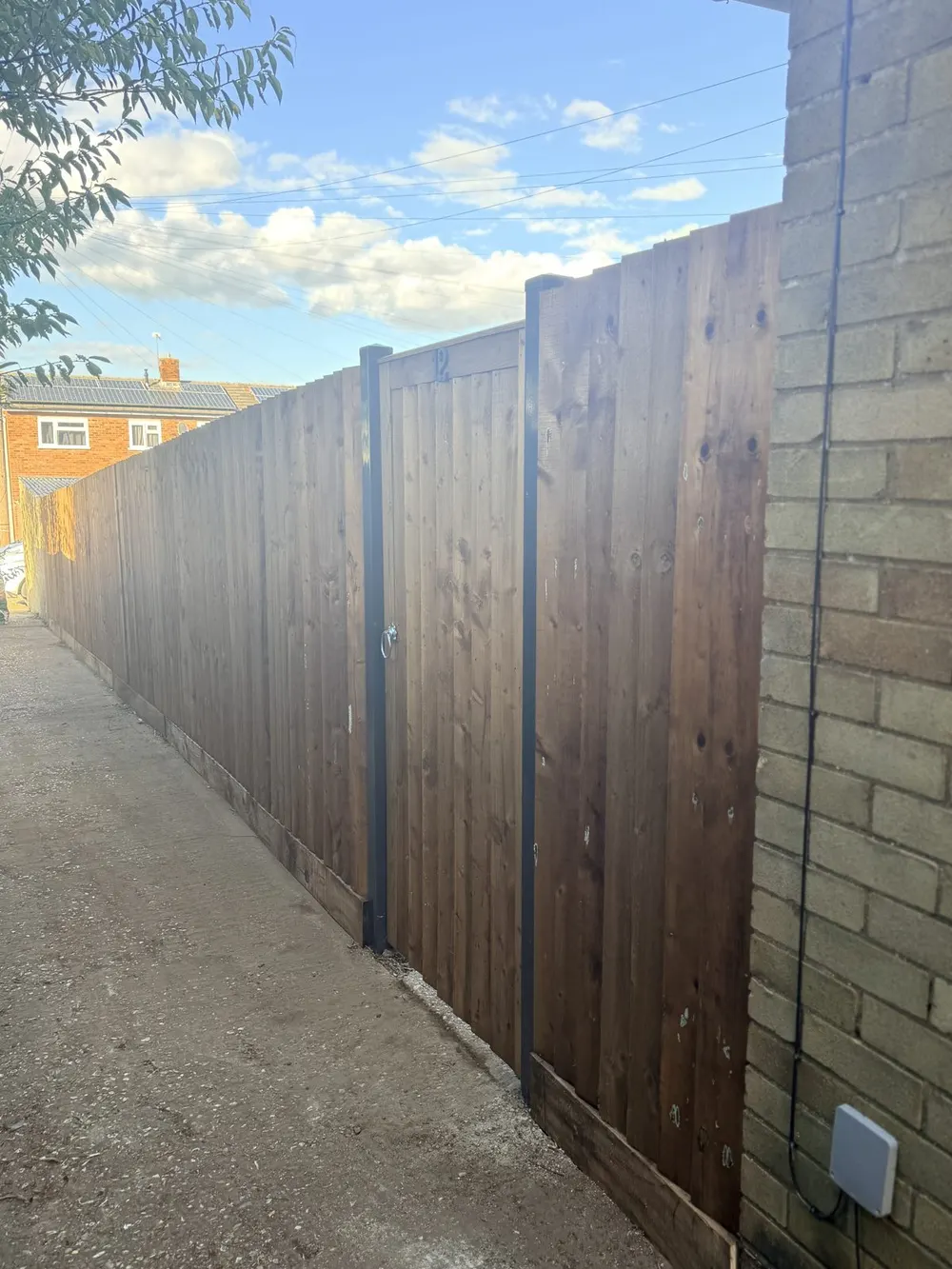
How a close board fence goes together
The structure starts with posts, set at regular centres along the line. Two or three arris or rectangular rails are fixed between each pair of posts, depending on height. At the base a gravel board keeps the bottom of the boards off the soil. The feather edge boards are then fixed vertically to the rails, thick edge overlapping the thin edge of the next, and a capping rail can be added along the top to shed rain.
Because each board is fixed individually, the fence follows the ground. Slopes, curves and uneven boundaries are easier to deal with than with fixed width panels, and a damaged board can be replaced on its own years later. The fence and gate on this page are an example of Craig's own work.
Posts, gravel boards and the parts you do not see
The posts carry the whole fence, so their material and setting matter most over time. Timber posts look consistent with the boards, while concrete posts are often chosen for their resistance to rot. Our guide to concrete versus timber fence posts sets out the trade-offs.
Gravel boards can be timber or concrete. Either way they take the splash and damp at ground level, which is where untreated or poorly protected timber fails first. Replacing a gravel board is far simpler than replacing a row of rotten board ends.
How much closeboard fencing do I need?
Measure the full run of the boundary in metres, following the actual line the fence will take. Then note the height you want and anything along the way: gates, corners, changes in level, trees and existing structures. From the length, the number of bays follows, usually at around 1.8 metre post centres, and from the bays come the posts, rails and gravel boards.
Boards are counted by how many cover each metre once overlapped, which depends on board width and how much each overlaps the next. Rather than work out every board yourself, send Craig the overall length, height and photos of the line, and the materials list is part of the quote.
Replacing an old boundary
Many close board jobs replace a tired panel fence or a run that has blown over. The old fence, posts and concrete are taken out first, then the new line is set out. Where the boundary position matters, agree it with your neighbour beforehand. Craig's fencing service covers panels, gates and repairs as well as this style. If the existing fence is repairable, our fence repair page explains what can be fixed.
Close board fencing installation costs
No figures are published here, because the cost of a close board fence depends on the job. The main factors are the total length, the height, timber or concrete posts and gravel boards, the condition of the ground, whether an old fence has to be removed and taken away, access along the boundary, and any gates. Our guide to fence replacement cost factors explains each one.
To get a quote, send the length, height and photos of the boundary along with your location, or call Craig to talk it through.