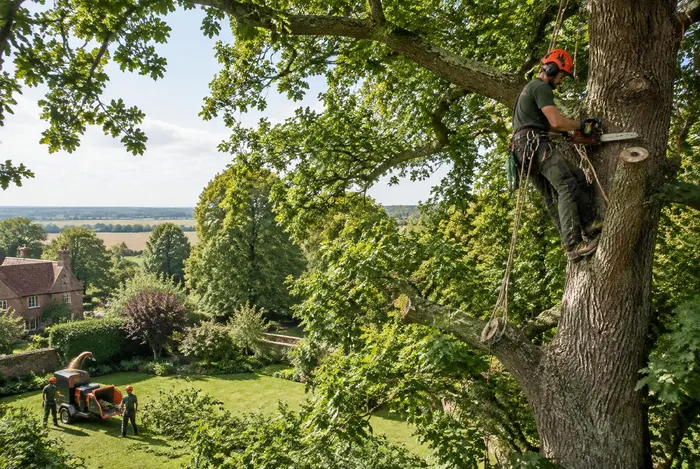
Deciding whether the tree needs to go
A dead or dying tree, substantial storm damage, or a tree in the wrong position can lead to a discussion about removal. The reason matters. If the concern is simply shading or a branch too close to the property, keeping the tree with suitable pruning may still be an option. Taking it down is a different decision from reducing growth while retaining it.
Describe what has changed and what you want the garden to be like afterwards. Photographs of the whole tree and its surroundings are more useful than a close view of the trunk alone. Craig’s broader tree surgery service covers the assessment of trees that may stay as well as those that need removing. This page explains the work once complete removal is the appropriate choice.
Straight felling where there is a clear landing space
Felling in one piece requires a suitable clear drop zone. The space around the tree, nearby structures and the condition of the timber influence whether that approach is appropriate. A tree in open ground is not automatically the same job as one of similar size in a narrow garden. The proposed method needs to reflect what surrounds it.
A straight fell is considered alongside access for dealing with the timber once it is down. It is not enough to find room for the standing tree to land: the resulting branches and trunk still need handling and either keeping or removing as agreed. Tell Craig about fences, sheds, paths and other features that are close to the work area.
Dismantling in sections when room is limited
Where buildings, walls or a small garden leave no suitable space for a whole tree, sectional dismantling allows it to come down in smaller pieces. Sections can be lowered where they cannot simply fall into clear ground. This is the approach already described in our tree surgery information for restricted spaces, and it is assessed for the particular tree rather than promised from a photograph.
A narrow entrance also affects how branches and timber leave the property. Photos of the access route help show that part of the job. The objective is a planned removal around the features that remain, not a guarantee that working beside a building or fence is free of risk. The method is explained before cutting begins so the agreed work is clear.
Check tree protection before arranging removal
A tree in your own garden may still be protected by a Tree Preservation Order or fall within a conservation area. Check with the local council before work where either may apply. Permission or the relevant notice needs to be in place before proceeding; ownership of the land does not remove those requirements.
Our tree protection guide explains how to check the position. Describe the tree and property accurately when contacting the council, and do not assume that visible damage settles the legal question. This service description does not promise to submit applications for you. The important first step is establishing what protection applies and what the council requires for the proposed work.
Timber, branches and the agreed clear-up
Once the tree is down, the trunk and branch material still need dealing with. Brash and timber can be gathered and removed as part of the job. If you want logs kept on the property, discuss that when asking for the quotation rather than assuming everything will either stay or leave. The clear-up should be part of the conversation from the outset.
Keeping wood also means deciding where it is to be left, while removal depends on a practical route out. A garden can have good access to the tree but an awkward route for carrying material to the vehicle. Showing both areas helps Craig assess the work that follows the cutting, not just the tree itself.
The stump and the next use of the space
Felling does not by itself remove the stump. You can leave it, have it ground below the surface, or have it dug out where that suits the ground and access. Stump removal is agreed separately so you can choose the finish you need. The tree stump guide compares the options, including what remains underground after grinding.
Think about the replacement before selecting that option. A lawn may need turf installation, a surface may need gravel, or a bed may need border planting. These are follow-on services to discuss, not automatic parts of a fell. Craig works from Brandon across Suffolk, Norfolk and Cambridgeshire for domestic and commercial customers. Read the tree removal cost guide for quotation factors, then send your location, photographs and intended finish for an assessment.