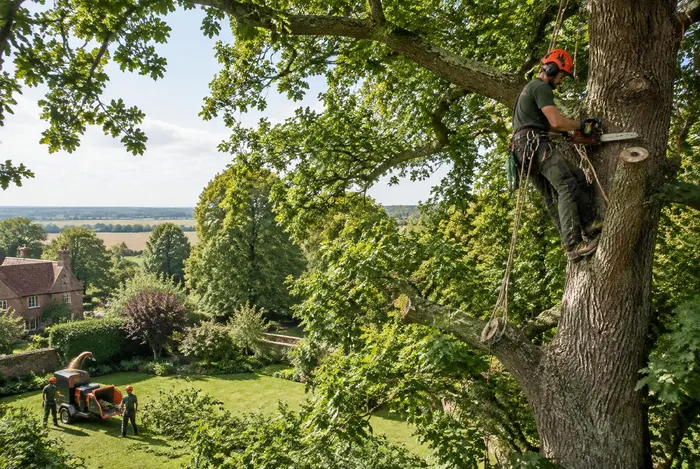
How pollarding differs from other pruning
Most tree pruning keeps the natural shape of the tree and simply makes it smaller, lighter or higher. Pollarding does something different. The branches are taken right back to knuckles at the top of the trunk or main limbs, and from those knuckles a cluster of new stems grows. Next time round, those stems are cut back to the same points again.
Over the years the knuckles swell into the rounded heads you see on street limes and riverside willows. Cutting into or below them breaks the pattern, so a pollard is always recut at the same place. If what you want is a smaller tree that still looks natural, crown reduction and lifting is usually the better route.
Which trees can be pollarded?
Trees that respond well to hard cutting make the best pollards. Willow, lime, plane, London plane, ash, hornbeam, mulberry, sweet chestnut and some maples have long been managed this way. Willows in particular regrow quickly and are often pollarded every two or three years.
Birch, cherry and most conifers do not respond well and are poor candidates. Large mature trees that have never been pollarded are also risky to start on, because big fresh cuts on old wood can let decay in. For trees like that, a reduction or a phased approach is normally safer, and Craig will say so if pollarding is not the right fit.
Starting a pollard and keeping it going
A new pollard is best formed on a young tree, cutting the stem or first branches at the height you want the head to sit. From then on the regrowth is removed on a cycle, commonly every one to five years depending on the species, how vigorous it is and how much screening or shade you want in between.
Old pollards that have been left for decades have heavy upright limbs sitting on small knuckles, which can split. Bringing a lapsed pollard back is sometimes possible over two or three visits, cutting a few limbs at a time, but some are past restoring and need a different plan.
When to pollard
Pollarding is normally done in late winter or early spring while the tree is dormant, before buds break. That timing gives the tree a full growing season to push new shoots. It also falls largely outside the main nesting season, though trees are still checked for birds. Our guide to when to prune trees explains how species and season affect timing more widely.
As with any tree work, check whether the tree has a Tree Preservation Order or sits in a conservation area before booking, as the council may need to approve the work or be notified first.
What decides the pollard price
There is no fixed pollard price because the work varies from one tree to the next. The main factors are the size and number of trees, how long it has been since the last cut, whether the tree can be reached from the ground or needs climbing, the space below for lowering branches and how much material has to be chipped and removed. A pollard kept on a short, regular cycle is generally quicker to recut than one that has been left to grow out.
For general shaping instead of pollarding, see tree pruning, and for bigger work, including felling, see tree surgery. To book, send Craig a photo of the tree and say roughly when it was last cut.