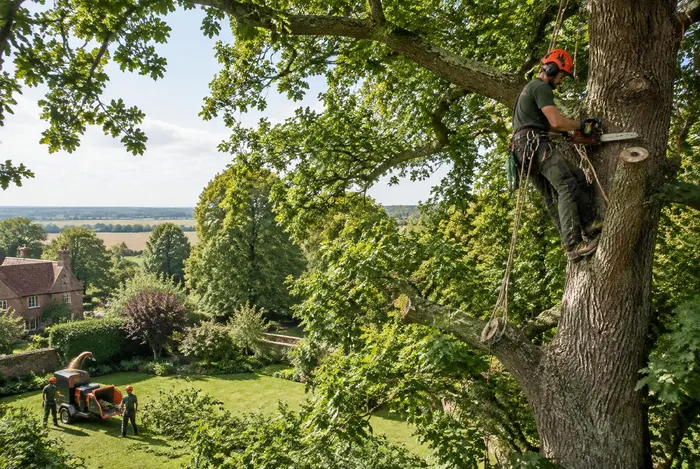
Tree pruning in Suffolk for trees you want to keep
Tree pruning is the work done to keep a tree healthy, safe and in proportion with the garden around it. Craig reduces, lifts, thins and removes deadwood from trees across Suffolk and Norfolk, so a tree can stay rather than come down.
This page is about trees that are staying. If a tree needs to be felled or removed altogether, that is covered on the tree surgery page.
Craig holds a Horticulture Level 3 diploma, which shapes how he approaches a cut: where to prune, how much to take and how the tree is likely to respond.
Fully insuredProfessional work with responsible site care.
Local coverageAcross Suffolk and Norfolk.
Tree trimming that keeps the tree in shape
Good pruning is mostly invisible. The tree should look natural afterwards, just smaller, lighter or clearer of the house. Poor pruning, such as cutting every branch back to the same point, leaves stubs that rot and causes a mass of weak regrowth.
Cuts are made at the right point on each branch so the tree can seal the wound, and the amount removed is kept within what the tree can cope with in one go.
The main types of pruning
Most tree trimming jobs use one or more of these, chosen for the problem you want solved.
Crown reduction: shortening the outer branches to bring the overall size down
Crown lift: removing the lowest branches to clear a lawn, path, drive or window
Crown thin: taking out selected inner branches to let more light through
Deadwood removal: cutting out dead and dying limbs before they fall
Trimming back: pulling branches away from roofs, gutters, walls and lines
When pruning is the right answer
Pruning suits a tree that is basically sound but has become too big, too dark or too close to something. A tree shading most of the garden can often be thinned and lifted rather than lost. A tree rubbing on a roof can be cut back from it. If a tree is badly decayed, leaning dangerously or in completely the wrong place, Craig will say so honestly and talk through removal instead.
Timing and protected trees
Many trees are best pruned in late autumn or winter while dormant, though some, such as cherries and walnuts, are better done at other times. Nesting birds are protected by law, so trees and shrubs are checked before any work in spring and summer.
If a tree is covered by a tree preservation order or stands in a conservation area, permission or notice is needed before pruning. Craig can explain how to check before the work is booked.
How a pruning job runs
Craig looks at the tree, agrees with you exactly what is coming off and why, and plans how branches will be lowered safely around the house, fences and plants below. On the day, the cut material is cleared, the garden is left tidy and the waste is taken away.
Fruit trees and smaller garden trees
Pruning is not only for big trees. Apples and pears that have become tall and tangled can be brought back to a manageable height over a couple of winters, which makes the fruit easier to reach. Ornamental trees that have outgrown a small garden can often be reshaped rather than replaced. Cherries and plums are pruned in summer, when the risk of disease getting into the cuts is lower.
Trees near houses and neighbours
Branches touching a roof, blocking gutters or reaching over a boundary are among the most common reasons people ask for tree trimming. Branches can be cut back to a sensible point so they do not reach the building again too quickly. Where a tree overhangs next door, it is worth talking to your neighbour first; Craig can explain what is usually reasonable to cut back.
What is the difference between tree pruning and tree surgery?
Pruning keeps a tree and improves it. Tree surgery on this site also covers felling and removing trees that need to come down.
Can a big tree be made smaller without cutting it down?
Often, yes. A crown reduction shortens the outer branches so the whole tree is smaller but keeps its natural shape.
When is the best time to prune a tree?
For many trees, late autumn to winter while dormant. Some species are better pruned at other times, and nesting birds must be checked for in spring and summer.
Do I need permission to prune my tree?
Only if it is protected by a tree preservation order or is in a conservation area. Your local council can confirm this.
Do you take the branches away?
Yes. Cut branches and debris are cleared and removed as part of the job.