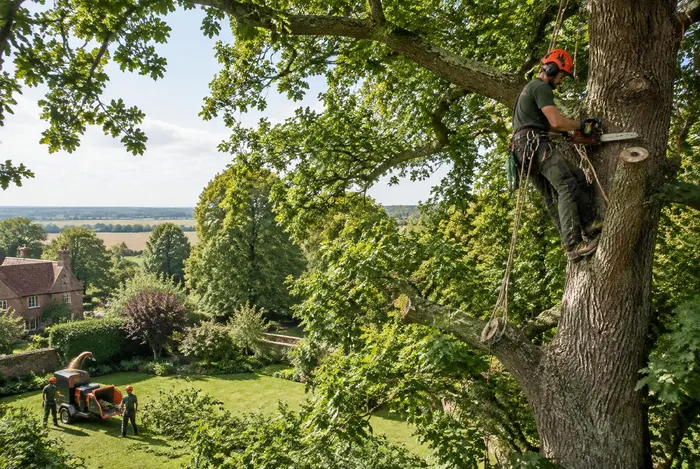
Give each tree an identifiable record
Where several trees occupy a walled garden or boundary, descriptions such as the large one at the back can cause confusion. Use a sketch with a reference for each tree, noting its position relative to the house, entrance and neighbouring features. Add the species if known, but label uncertain identification honestly.
Take dated photographs showing the whole crown, trunk base and particular feature prompting the enquiry, provided this is safe. Record when you noticed a change and whether earlier pruning documents exist. This is useful preparation for discussion, not a formal survey, condition diagnosis or substitute for any specialist report the circumstances require.
Check the address, boundary and protection status
For a property in Ely's historic centre, check conservation area boundaries rather than deciding from the age of the house or the appearance of the street. Confirm the actual property and tree location with East Cambridgeshire District Council. Ask about Tree Preservation Orders as well as conservation area boundaries, retaining the response alongside your sketch and photographs.
Work to a tree protected by a Tree Preservation Order generally requires the council's consent unless a specific exception applies. For qualifying trees in a conservation area without a TPO, six weeks' written notice is normally required before work. The Tree Preservation Orders guide gives general background. This page is general guidance, not legal advice or an individual permissions assessment.
Turn the concern into a measurable proposal
Separate what you observe from what you want changed. Branches over a passage, foliage near a window and a broken limb are different issues. A useful proposal identifies the relevant tree and branches, describes the intended operation and gives meaningful dimensions where appropriate. Avoid vague instructions such as tidy heavily, which leave the extent unclear.
Crown reduction and lifting address different parts of a retained canopy. Reduction decreases specified crown dimensions through selected branch shortening; lifting increases space beneath the crown by removing selected lower growth. Neither operation is automatically suitable. The tree's structure, species and condition should inform the proposal, rather than selecting a name before understanding the problem.
Keep the proposal aligned with the documents
Check that any application, notice, decision and quotation refer to the same tree and operation. Record conditions and relevant dates. A document concerning a neighbouring tree does not establish the position for yours. If the intended extent changes during discussion, establish whether revised information or a further application or notice is needed before proceeding.
Where tree removal is proposed, distinguish that clearly from pruning. Explain the reason and the consequences for the garden, rather than treating removal as a stronger version of reduction. The tree surgery overview helps place individual operations within the wider decision about retention and management.
Add site constraints and handle urgency accurately
Include narrow entrances, shared passages, walls, overhead lines and space for handling cut material in the record. Ely's town plots and surrounding gardens do not share one access arrangement. State whether branches or timber should remain, and keep unrelated garden changes outside the tree specification unless separately agreed.
Suspected danger is not a universal exemption from tree controls. Specific exceptions have limits, and council advice and evidence may be needed. Keep away from unstable branches rather than approaching for photographs; immediate danger to life requires emergency assistance. Wildlife restrictions also need consideration. Share your information through contact, or use the Ely area page for wider local services.