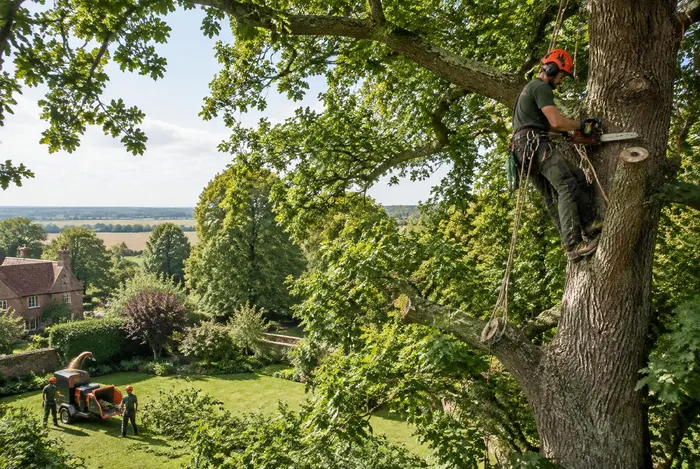
Map the boundary before planning the operation
Newmarket's stud and training setting makes boundary planning a useful starting point, without assuming every property is equestrian. Mark the trunk, fence, neighbouring land and any branches extending over grazing. Establish ownership and who can authorise access. A fence beside the tree does not, by itself, settle the legal boundary or ownership of the trunk.
For a stud or paddock enquiry, identify horse movements, occupied areas and gates that must remain secure. Discuss noise, machinery positions and where material could be handled without entering animal space. Ordinary town gardens need an equally clear access plan, particularly where a shared route links several properties or a narrow entrance separates the tree from the road.
Specify what retaining the tree should achieve
A branch above a horse walk presents a different question from a crown spreading across a garden. Describe the clearance needed and the feature affected before choosing an operation. Tree pruning concerns selected growth on a retained tree; it should not become an instruction to strip back every branch crossing an imagined vertical line.
Crown lifting removes selected lower branches to increase clearance beneath the canopy. Reduction shortens selected branches to reduce crown dimensions while considering the remaining structure. Species, vitality and earlier cuts influence suitability. Repeated severe cutting can create further management problems. The broader tree surgery service connects these options without treating them as interchangeable.
Keep animal arrangements separate from cutting decisions
Agree with the person responsible for the horses how animals will be separated from the working area. Do not rely on a horse tolerating machinery because it has heard similar noise before. Access routes, temporary barriers and responsibility for opening gates need discussing before equipment arrives, especially where several people use the same entrance.
Branches, foliage, sawdust and small fragments should be considered in the clearance specification. Some tree material can be harmful to horses, so species and contamination concerns warrant appropriate veterinary advice rather than assumptions about safe grazing. Decide who checks the affected area and authorises animals to return after the agreed clearance.
Removal and stump grinding have different end points
If retention is unsuitable, tree removal addresses taking down the standing tree. The intended handling of timber, branches and the remaining stump should be explicit. Removing a boundary tree may alter shelter or screening, while equipment access could conflict with rails, water supplies or buried services.
Stump removal and grinding needs its own end use discussion. Leaving ground for grazing, preparing a fence position and creating a usable garden corner are different briefs. Grinding reduces stump material below the surface but does not necessarily remove every root. Agree depth, handling of grindings and the required finish rather than assuming felling leaves construction-ready ground.
Resolve restrictions before agreeing the date
Check for Tree Preservation Orders and conservation area controls with the relevant planning authority. Protected work generally needs consent; qualifying conservation area work normally requires six weeks' written notice. Exceptions have specific limits. Describing a tree as dangerous does not automatically authorise unrestricted cutting. Wildlife protections, including active nests and bat roosts, remain relevant. This is general guidance, not legal advice.
Send the postcode, boundary photographs, access details and intended outcome through contact. Include animal arrangements where relevant and identify any documents already obtained. The Newmarket area page provides wider local context when other garden or boundary tasks need sequencing around the tree decision.