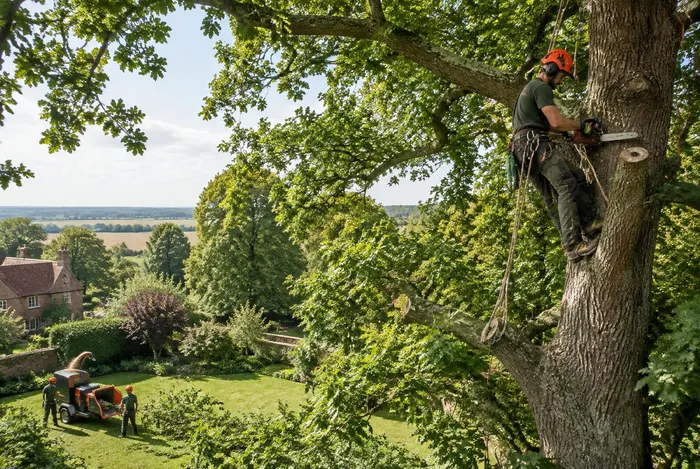
Tree work in a cathedral city on the Wensum
Norwich is a cathedral city, the county town of Norfolk, on the River Wensum. Across Norwich, 32.0% of homes are terraced and only 10.3% detached (Census 2021), so many city gardens are long, narrow plots behind terraces where a single overgrown tree can dominate several gardens at once. Craig travels in from Brandon for felling, dismantling, reductions and crown work across the city and its suburbs.
City tree work is mostly sectional dismantling: taking a tree down piece by piece because there is nowhere to fell it whole. Branches are lowered on ropes over sheds, greenhouses and conservatories, and everything is chipped and taken out through whatever access the property has, which on a terraced street can mean through the house or a narrow side passage.
Conservation areas and protected trees
Conservation areas cover the City Centre, Thorpe Hamlet, Heigham Grove, Unthank and Christchurch, Newmarket Road, Mile Cross, Sewell, Trowse, Bracondale, St Matthews and Thorpe Ridge, and around 500 listed buildings stand within about 2 km of the centre, 37 of them Grade I. Norwich City Council protects trees both individually through Tree Preservation Orders and collectively within those areas. Before pruning or felling, six weeks' notice to the council is normally required for trees in a conservation area, and formal consent for protected trees.
Suburbs such as Thorpe St Andrew, Hellesdon and Costessey sit outside the city boundary, so planning questions there go to Broadland or South Norfolk councils rather than Norwich City Council. It is worth checking before booking anything. The check costs nothing and avoids enforcement problems later. Craig will flag what to look into when quoting, and our guide to tree preservation orders explains how to find out where a tree stands.
Common Norwich tree jobs
The jobs Craig is asked about most in Norwich follow the city's layout. In the older areas it is crown reductions on mature broadleaf trees that have outgrown modest gardens, lifting low branches off roofs and out of gutters, and removing dead or declining trees from tight plots. Around the newer edges of the city, fast growing conifers and self seeded trees on boundaries are the usual calls. Rainfall is low and sunshine relatively high for an inland area, so drought stress in a dry summer is worth raising when discussing the timing and extent of pruning.
Where a tree has to come down, tree removal covers felling and dismantling, and the stump can be ground out afterwards so the ground is usable again. After storms, the emergency tree works line handles fallen and dangerous trees; no specific response time is promised, but urgent situations are prioritised.
How work is planned and quoted
Every Norwich job starts with the tree and its setting: species, size, condition, what stands beneath it, and how branches and waste will get from the back garden to the vehicle. On terraced streets, access and parking are agreed in advance so the day runs without surprises for you or the neighbours.
Quotes are given in writing after seeing the tree, naming exactly what will be done, whether waste is removed and whether the stump is included. Send photos of the whole tree, the base and whatever it overhangs, plus your postcode, for an initial view, or arrange a visit through the tree surgery page.