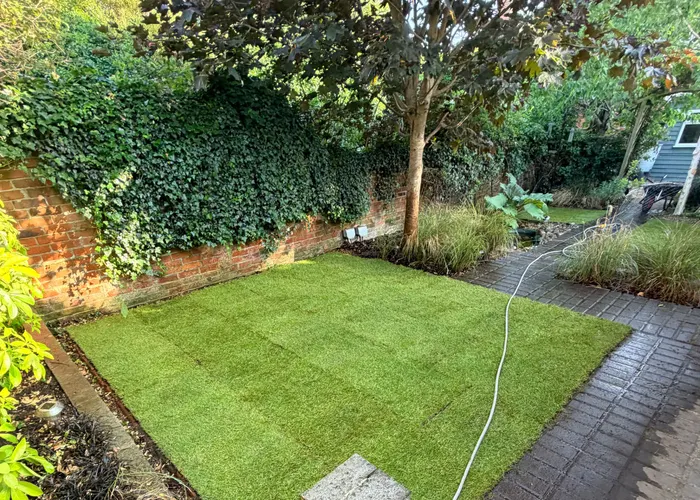
Establish what the old lawn is telling you
Bare areas, uneven growth and standing water can have different causes. Before replacing the surface, note shade, foot traffic and where water collects after rain. A new lawn is not a guaranteed cure for deep compaction or unsuitable drainage. Understanding the problem helps distinguish a realistic replacement from covering the same conditions with fresh grass.
Ipswich gardens range from compact rear plots to larger residential lawns, each with different light and access. Buildings, fences and retained trees can affect the growing area. Give the garden dimensions as an initial guide and show the whole plot in photographs. A close-up of a bare patch does not reveal the levels or the route for removing old material.
Prepare levels around fixed features
The turf installation service is the route for discussing stripping, preparation and laying. Finished levels must work with paths, doors, drains and fence bases. An apparently small increase in ground height can create an awkward edge or direct water somewhere unsuitable. Those relationships need to be checked before the new surface is formed.
Old roots, rubble and buried obstructions can affect preparation. Mention known services and any history of building waste or earlier landscaping. Agree the scope for removing unwanted material rather than assuming a quoted lawn area defines every below-ground task. The prepared bed should support rooting, not simply provide a smooth-looking surface on the day.
Timing depends on the site and aftercare
The guide to when to lay turf explains the general seasonal considerations. Conditions at the property still govern whether preparation and laying are practical. Frozen or saturated ground and a lack of watering arrangements can make a preferred date unsuitable. Avoid scheduling purely around when the garden must look finished for an event.
Access should also be considered for delivery and moving turf promptly into position. A narrow side entrance or steps can affect handling. Make room for work without blocking essential shared routes, and agree which existing planting must be protected. Turf is a living material, so the sequence between preparation, delivery and laying matters.
Watering and first use are part of the project
New turf aftercare covers the period after installation. Plan access to water and how you will check that moisture reaches the prepared ground. Weather changes the need; a brief surface spray is not automatically sufficient, while waterlogging is not helpful either. Follow the advice given for the actual lawn and current conditions.
Heavy use should wait until establishment is appropriate. Furniture, play equipment and repeated foot traffic can damage new turf before the roots have formed useful contact. The timing of an initial cut also depends on growth and rooting, not a promised universal date. Craig does not offer lawn treatments, and installation does not imply an ongoing treatment package.
Compare the full scope of turfing
The turf laying cost guide explains why access, preparation and the site affect a quote. Compare equivalent removal and ground work, not only the area of visible grass. State what should happen to the old lawn and whether edges or adjoining surfaces need a separate agreement.
Send the postcode, approximate area and photographs through the quote form, including the entrance and watering access. For other work at the property, the Ipswich hub links to gardening, landscaping, fencing and tree pages. Resolve overlapping jobs before laying so new turf is not immediately crossed by another operation.